












How to Tell if Someone Is Tracking Your Car
Aug
Let’s start with the reassuring part. If you think someone is keeping tabs on where you drive, you can usually find out for yourself. Trackers have gotten small and cheap, and it takes only a few seconds to stick one on a car. A suspicious partner, a nosy employer, a private investigator, a thief sizing up your vehicle, any of them could be behind it. The thing is, most hidden trackers are far easier to find than people expect. Spend half an hour with a flashlight and you’ll usually have your answer. Below, we’ll walk through how to tell if someone is tracking your car, the signs worth paying attention to, the spots these devices like to hide in, how to confirm a suspicion, and what to do once you have.
Why Would Someone Track Your Car?
It helps to think about who would bother in the first place. Tracking a car isn’t shady by default; plenty of people track their own vehicles for perfectly good reasons. It only becomes a problem when it’s done to you, without your say-so. A few of the usual motives:
- A controlling or jealous partner. They want to know where you go and who you see, and they’d rather not ask.
- A thief. They tag a car they plan to steal, then wait for a night you leave it somewhere quiet.
- A private investigator. Someone hired to log another person’s comings and goings, often during a divorce or custody dispute.
- An employer. Keeping an eye on a company car without mentioning it to the person driving it.
- A stalker, or someone holding a grudge. The most serious case of all, and the reason this is worth taking seriously.
Warning Signs Someone Is Tracking Your Car
A tracker won’t announce itself. The people using one, though, tend to slip up. These are the things that usually give it away:
- They always seem to know where you’ve been. If someone keeps bringing up places you never mentioned to them, that’s the biggest tell there is.
- Marks you don’t remember. Fresh scratches, scuffs, or fingerprints around the bumpers, wheel wells, or under the dashboard that weren’t there last week.
- Your battery keeps going flat. A tracker wired into the car pulls a little power day and night. On an older battery, you’ll start to notice.
- Someone had access to your car recently. A repair shop, a valet, an ex who borrowed it for the weekend. Any time the car leaves your hands is a chance for someone to plant something.
- A gadget you don’t recognize. A small box stuck to bare metal, or a dongle plugged in somewhere nothing used to be.
Types of Hidden GPS Trackers to Look For
It’s much easier to spot something when you know what you’re looking at. Trackers come in a handful of shapes:
- Magnetic, battery-powered units. About the size of a matchbox and held on by a magnet. They run on their own battery, so whoever placed it has to reach it now and then to recharge. That usually means it’s somewhere accessible, like a wheel well.
- OBD-II plug-ins. These slot straight into the diagnostic port under your dashboard, down near the pedals. They draw power from the car itself, so they never need charging and can sit there for years.
- Hardwired trackers. Wired into the car’s electrics and tucked well out of sight. These are the difficult ones; they usually take a professional to fit and a professional to find. You’ll see them most often on stolen-vehicle recovery setups and fleet cars.
- AirTags and Bluetooth tags. Not GPS, strictly speaking, but worth a mention. An AirTag or a Tile costs next to nothing and drops easily into a glovebox or a seat pocket. Less precise than GPS, but turning up more and more.
How to Check Your Car for a Hidden Tracker
Give yourself half an hour, park somewhere with decent light, and work through the car in sections rather than poking around at random. A flashlight makes a big difference, and so does a small mirror on a handle plus a pair of gloves for the grubbier corners.
1. Outside and underneath
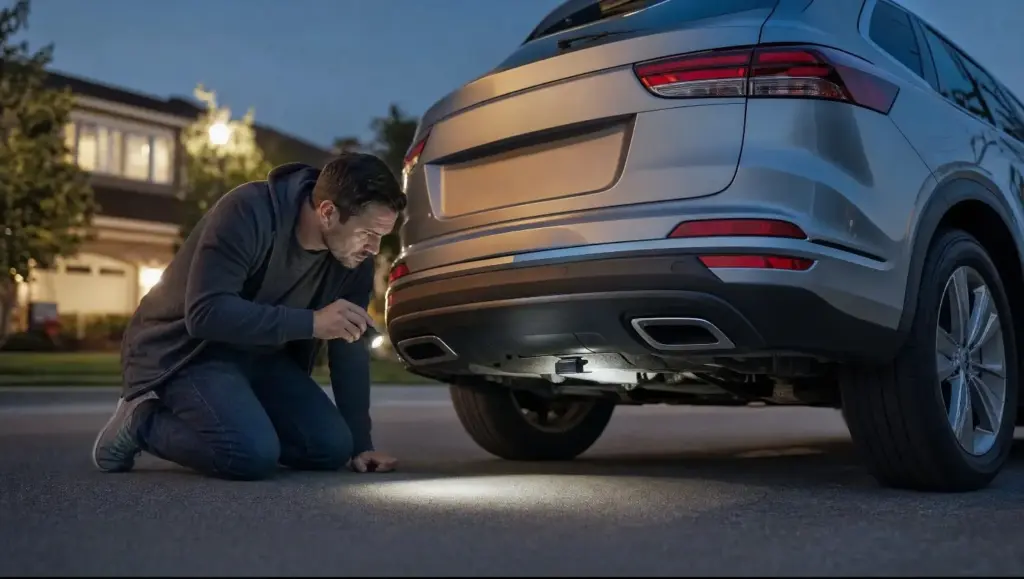
- Run your fingers and a flashlight around each wheel well. It’s the number-one hiding spot: metal, magnetic, and out of sight.
- Look under both bumpers and along the frame for anything stuck or taped in place.
- Check the undercarriage. If you’d rather not crawl under, hold your phone underneath and snap photos, or use a mirror on a handle.
2. Inside the cabin
- Get under and behind the dashboard, and check the OBD-II port by the driver’s footwell for anything plugged in that shouldn’t be.
- Feel under the seats, in the seat-back pockets, under the mats, and through the glovebox and center console.
- Run your hand along the underside of the dash and the steering column, where something small can sit unnoticed.
3. Trunk and engine bay
- Lift the spare-tire cover. The well underneath is roomy and almost never opened, which makes it a favorite.
- Check the trunk lining, the side cubbies, and any tool kit that came with the car.
- Pop the hood and take a look, but keep well clear of anything hot or moving.
Tools and Apps That Help You Detect a Tracker
Searched everywhere and still can’t shake the feeling? A couple of tools can settle it:
- An RF detector. This handheld gadget picks up the signal a tracker sends when it phones home. The catch is that many trackers only transmit every so often, so go slowly and sweep the car more than once.
- A Bluetooth scanner app. If it’s an AirTag you’re worried about, an iPhone will warn you when an unknown tag keeps traveling with you, and there are free apps (Apple’s own, plus a Google one for Android) that scan for nearby tags.
- A professional sweep. For a tracker buried in the wiring, a mechanic or a licensed investigator with proper sweep gear can reach what you can’t.
What to Do if You Find a Tracker
Finding one is a jolt, and the instinct is to rip it straight out. Try not to. A few minutes of care now will serve you far better:
- Photograph it first. Get clear shots of the device and exactly where it was sitting before you touch anything. That’s your evidence.
- Think about who put it there. If it points to an ex, a stalker, or anyone who makes you uneasy, don’t go and confront them about it.
- Call the police. Tracking someone without consent is often a crime. Hand over your photos and let the officers advise on the safest next step.
- Only remove it when it’s safe to. If nobody dangerous is in the picture, take it off or turn it in. But if there’s any chance an abusive partner is behind it, know that removing the tracker can tip them off, so get advice before you do anything.
A note on safety: if you believe an abusive partner or a stalker is the one tracking you, your safety comes before everything else. Taking the tracker off can signal to that person that you know. Before you touch it, think about reaching out to a local domestic-violence helpline or the police, who can help you plan around it.
Using GPS Tracking the Right Way
One last thing worth saying. There’s nothing wrong with GPS tracking itself; the problem is tracking someone who never agreed to it. Out in the open, a tracker is one of the more useful things you can own. Put one on your own car and, if it’s ever stolen, you can hand the police a live location instead of a description, which is often the difference between getting it back and never seeing it again. Parents fit them to a teenager’s first car. Businesses use them to keep a fleet running.
That’s really the whole idea behind what we build at PAJ GPS. Live location through the PAJ FINDER Portal, a full route history, an alert the moment the car moves when it shouldn’t, all of it running on a device you own and control. If peace of mind is what you’re after, a tracker working for you beats lying awake over one you can’t see.
Frequently Asked Questions
Can a GPS tracker be hidden inside my car where I can’t see it?
It can. Hardwired ones get tucked into the wiring behind the dash, and small battery units disappear into the spare-tire well or behind a trim panel. Those are the ones you may not turn up without a bit of help.
Is it legal for someone to put a tracker on my car?
Usually not, if they don’t own the car and you never agreed to it. The exact rules change from country to country, so if you think someone is tracking you without permission, report it to your local authorities.
Will a tracker drain my car battery?
A hardwired or plug-in tracker sips a trickle of power around the clock, and on an older battery that adds up over time. Battery-powered units, on the other hand, don’t touch your car’s electrics at all.